The rough arithmetic on what a flat all-hands or conference costs a business, in time, trust, engagement and people, for anyone who has to defend the budget or cut it.
The only number anyone writes down
Every internal event produces one number the business keeps: the invoice. Venue, production, catering, travel. It goes in a spreadsheet, and next year someone asks whether it can be smaller.
What the event did never gets a number. The conference ran to time. The CEO's slides worked. People clapped in the right places, had lunch and went back to their desks. By Thursday nobody could tell you what the three priorities were. Ask anyone how it went and you get the same answer: it was fine.
Fine is where the cost hides. This article puts a rough number on it, so the next budget conversation has two columns instead of one. The argument in one sentence: a bad internal event costs far more than its invoice, because the real bill arrives afterwards in lost trust, lower engagement and people leaving, and once you count that, the event stops being a discretionary spend and becomes a risk decision. The figures are estimates, built from published research and simple maths. The point is not precision. The point is that nobody does the sum at all.
The cost in 60 seconds
- The invoice is the smallest part. For a 300-person event, a day of everyone's time is worth around £52,000 in salary before you have paid for the room (ONS median salary, 2025).
- An event that changes nothing still costs all of that, and returns nothing for it.
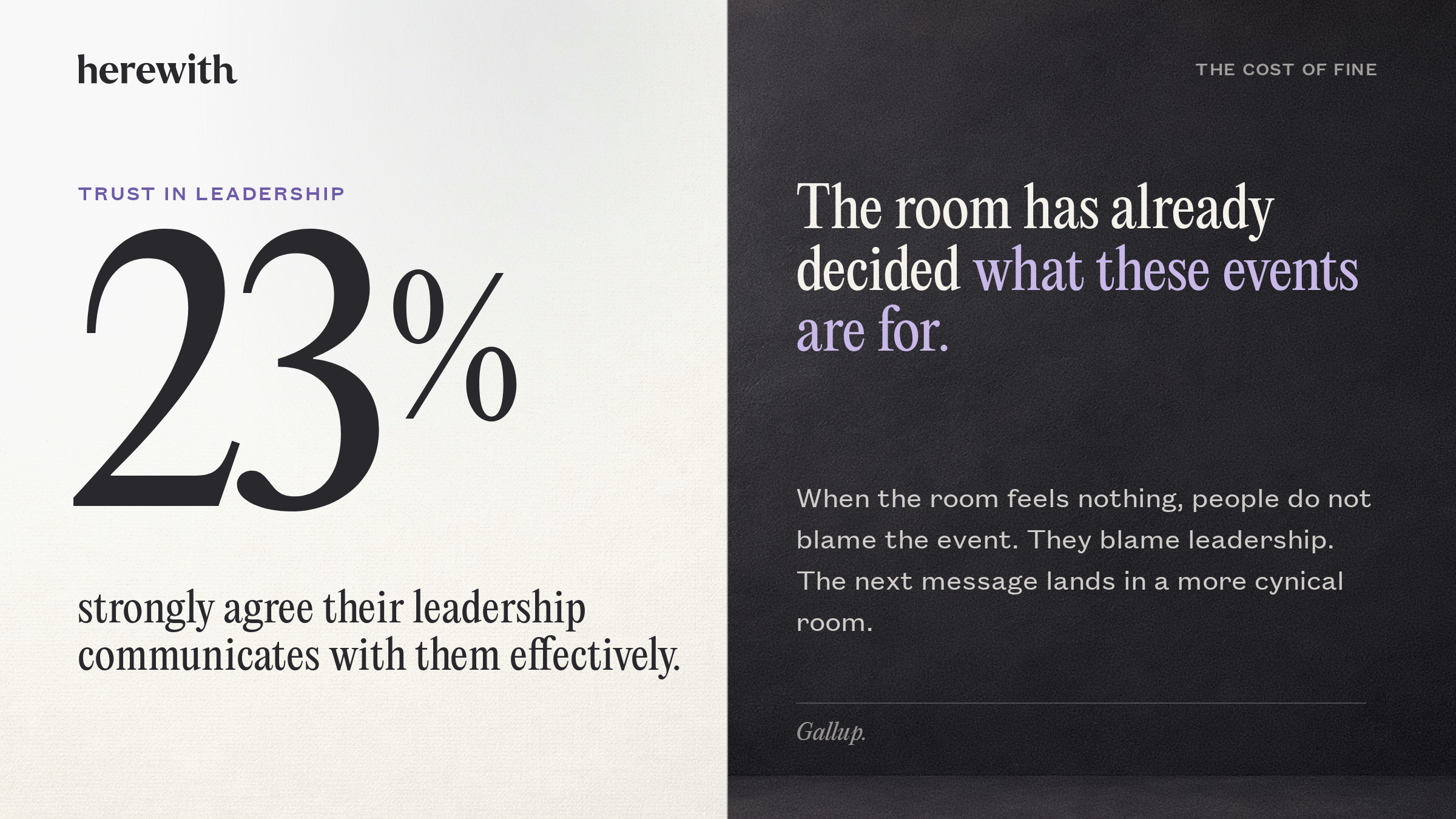
- Only 23% of employees strongly agree their leadership communicates effectively (Gallup). Every flat event adds to that.
- Low engagement cost the world economy around $10 trillion last year, and Europe is the least engaged region in the world at 12% (Gallup, 2026).
- Replacing one person costs half to twice their salary (Gallup). Two extra leavers cost more than the whole event.
- So the question is not "can we afford this event?" It is "what does it cost us if it doesn't land?"
Why nobody counts the rest
The cost is spread out and delayed. A flat conference does not produce a line item. It produces a slightly more cynical room, a strategy that is half remembered and a few people who quietly update their CVs. Each of those shows up months later, somewhere else in the business, and gets blamed on something else.
And nobody has an incentive to count it. Finance sees a discretionary line. The team that ran the event does not want to audit it. Agencies do not want to either, because if a bad event has a cost, the agency is accountable for it. We think that is exactly the point, which is why we are writing this.
The four costs of an event that changed nothing
1. The day itself
Take a 300-person company and a one-day event. The UK median full-time salary is £39,039 (ONS, April 2025), which is about £174 per person per working day. Three hundred people for one day is around £52,000 in salary, before employer costs, travel or preparation time.
Then add the invoice. At a modest £150 a head for venue, production and food, that is another £45,000. So an unremarkable event for 300 people costs close to £100,000 once you count the people in the room. Most budgets count the second half only.
What it means for the business. A flat day and a highly-impactful day cost the same. The only difference is what you get back.
2. Trust
A corporate event is usually leadership asking for something: believe in this direction, back this change, trust us. Gallup finds only 23% of employees strongly agree that their leadership communicates with them effectively. Around 80% of leaders think their communication is clear. Only about half of employees agree.
A flat event widens that gap. When leadership says the year ahead is exciting and the room feels nothing, people do not conclude that the event was badly designed. They conclude that leadership is out of touch. One manager on Reddit put it bluntly: most all-hands "resemble a hostage situation". Every mediocre one confirms it.
The MacLeod Review, the UK government's study of employee engagement, put it more carefully: attempts to manufacture engagement "are seen through quickly and breed cynicism". Cynicism compounds. The fourth flat event is judged by the previous three before anyone has said a word.
What it means for the business. The next message leadership needs to land, the restructure, the new strategy, the difficult year, will be heard by a room that has already decided what these events are for.
3. Engagement
Gallup's 2026 State of the Global Workplace puts engagement at 20% worldwide. Europe is the lowest region at 12%, with 73% of employees not engaged and 15% actively disengaged. Gallup estimates low engagement cost the world economy around $10 trillion in lost productivity last year, roughly 9% of global GDP.
In Gallup's latest meta-analysis of more than 180,000 teams, top-quartile business units for engagement were 23% more profitable than bottom-quartile ones, with 78% lower absenteeism and 21% to 51% lower staff turnover.
A company-wide event is one of the very few moments where a business works on engagement for everyone at once. When it lands, people leave knowing where the company is going and why their work matters to it. When it does not, they leave with nothing, and memory does the rest: without reinforcement, around 70% of new information is gone within a day and 90% within a week. That is why "it went fine" and "nothing changed" are the same sentence.
What it means for the business. Nobody can claim one flat conference moves an engagement score. But a business that spends six figures on the one moment designed to move it, and gets nothing, has spent the money and kept the problem.
4. People leaving
Gallup puts the cost of replacing an employee at one-half to two times their annual salary, and calls that conservative. On the UK median salary, that is roughly £20,000 to £80,000 per person.
Put that next to the event. Two extra leavers cost more than the entire all-hands, room and people included. The event does not need to cause a resignation to be a bad bet. It only needs to fail to prevent one.
And prevention is what a well-designed moment does. BetterUp's research found employees with a strong sense of belonging have a 50% lower risk of leaving. Belonging is built in rooms, when people see each other, hear the same thing at the same time and leave with a shared reference point.
What it means for the business. When a People Director asks for the event budget, they are not asking for a party. They are asking for one of the cheapest retention tools the business has, and being told it is discretionary.
A rough estimate for a 300-person all-hands
The whole sum in one place, assumptions showing.
- Salary cost of the day: 300 people × £174 = about £52,000 (ONS median, 225 working days, before employer costs)
- The invoice: 300 × £150 = £45,000 (your figure will vary)
- Cost of the day, whether it works or not: close to £100,000
- Cost of replacing one person who leaves: £20,000 to £80,000 (Gallup, on the median salary)
- Extra leavers it takes to wipe out the event budget: two
- Cost of a leadership message that does not land: no clean number, but it is paid at the next one
The invoice everyone argues about is less than half the real cost of the day, and the downstream numbers are so much bigger that even a small effect on whether people stay, or believe, changes the decision completely. That is what a risk decision looks like.
A risk decision, not a spend
We spoke recently with a company that spends a six-figure sum a year on events. The bookings were handled well. Each event was planned, happened and ended. When we asked what any of them had changed, the honest answer was that nobody had ever asked. There was a calendar, but no plan behind it, no follow-up and no measure of what people did differently afterwards.
That is the normal state of internal events in most businesses, and it is not anyone's fault. An event calendar books dates. It does not ask what each date has to change.
Treating the event as a risk decision changes three things. It changes the question: not "can we afford it?" but "what has to be different in people on the Tuesday after, and what does it cost us if it isn't?" That is a question a CFO can engage with, because it has a downside. It changes the brief: if the moment has to make 300 people believe in a new direction, the brief is that, and the format follows. If it only has to pass on information, an email is cheaper and you should say so. And it changes who is accountable: whoever designs the event is accountable for whether the risk was managed. That includes us. It is a standard most agencies would rather not sign up to.
The line to take upstairs is the one we use ourselves. The question is not what the event costs. It is what it costs when the moment does not land.
How to stop paying the bill
Five things, all doable before the next budget meeting.
- Do the sum. Count the day of everyone's time as well as the invoice, and put both numbers in front of whoever signs off. The case for making the event work looks different at £100,000 than at £45,000.
- Ask one question about last year's event. What changed in the 30 days after? If nobody can answer, that is the cost, and it is worth saying out loud.
- Reframe the decision. Replace "can we afford this?" with "what does it cost if this doesn't land?" Bring the replacement-cost figure. Two leavers is an argument a finance director understands.
- Design the two things people remember, and the week after. People remember the peak of an experience and how it ended, far more than the middle. Design the opening and the close, and plan the follow-up before the event, because forgetting starts the moment people leave.
- Judge the event, and whoever makes it, on the outcome. Ask your agency, or your own team, what they will be accountable for beyond the day running smoothly. If the answer is nothing, you are buying a booking.
This is the work we do at Herewith, and the accountability is the point. Weeks after two employee benefits businesses merged, we designed the first day their 450 people would spend in one room. On paper it was a conference. The real brief was the risk: if the day fell flat, two companies would leave the room still two companies. So the day was built around that. A networking game gave people a reason to seek out colleagues from the other business, and the room stayed one room into the night. The cost of that day was real. The cost of the alternative would have been paid for years.
The same thinking applies to a company-wide conference or all-hands, a restructure or merger, or the case for the room itself, which we set out in why in-person events matter. Events end. Their impact shouldn't. The job is to make sure the impact is the thing you paid for.
FAQ
How much does a bad internal event cost?
More than its invoice. For a 300-person one-day all-hands, the salary cost of the day alone is around £52,000 on the UK median wage, before venue and production. The bigger costs come afterwards: lower trust in leadership, the engagement gap Gallup values at $10 trillion globally, and turnover, where replacing one person costs half to twice their salary. Those figures are estimates, but they are large enough that a flat event is rarely the cheap option.
How do I measure whether an all-hands worked?
Decide before the event what should be different afterwards, then check. Pick two or three observable things: can people name the priorities a week later, did cross-team conversations start, did anyone act on what they heard? Ask at 30 days, not on the way out. A satisfaction score on the day tells you about lunch. The 30-day answer tells you whether the money did anything.
Is it better to cancel than run a mediocre event?
Sometimes, yes. If the moment only needs to pass on information and there is no plan to make it do more, an email is cheaper and costs no trust. But cancelling has a cost too. A business with no shared moments builds no shared belief, and Europe's 12% engagement figure is partly the result. The better answer is usually to run fewer events and design each one to change something specific.
How do I justify the event budget to a CFO?
Put both columns on the table. On one side, the real cost of the day including everyone's time. On the other, what it costs when the moment does not land: the next message heard by a more cynical room, and the replacement cost of the people a good moment would have kept. Then state what this event has to change and how you will check. That turns a discretionary spend into a risk decision, and finance directors are good at those.
If you are about to defend an event budget, or cut one, tell us what the moment has to change. We will say honestly whether an event is the right tool for it, and if it is, how to make sure it lands. We come back within one working day. Tell us about your event.


.jpeg)