

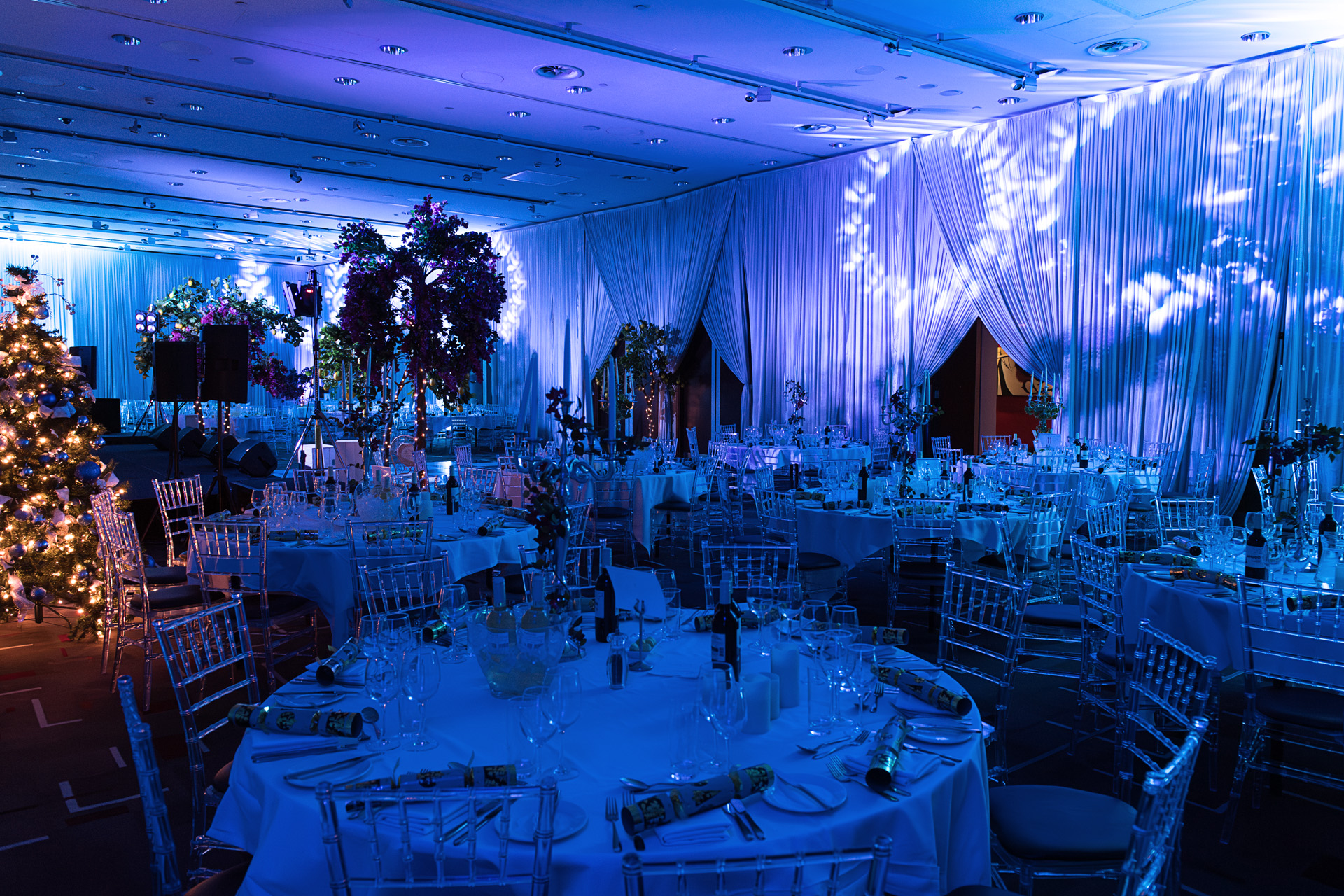
A site visit checklist for EAs, Ops leads and Internal Comms owners who have been handed a conference, away day, awards night or launch and are about to sign a venue contract.
Most venue problems are visible before the contract is signed, if you ask about them. The room that holds 300 for drinks but 140 in cabaret. The "included" AV that turns out to be a projector and a lectern mic. The loading bay that closes at 6pm when your build finishes at 9pm. None of these are surprises to the venue. They become surprises to you because nobody asked. These are the questions to ask before booking a venue, in the order we ask them on a site visit, with the reasoning and what a bad answer sounds like.
Decide the format first, then look at venues
The right venue is the one that fits the format the event needs, and you can only judge that once the format is decided. Book the venue first and the format bends to the room. The workshop becomes a plenary because the room only works theatre style.
So before any site visit, settle what the day has to do: how many people, in how many sessions, in what layouts, with what production. Whether it is an internal conference or all-hands, an away day or an awards night, write it on one page and take it with you. Every question below tests whether the venue can run that page.
That is how we chose the venue for the Perkbox brand launch. The brief needed a conference, product games and an evening party on the same day. BoxPark Liverpool's multi-space layout could run all three at once, with no room turnaround. The format came first and the venue was found to fit it.
The 10 questions to ask before booking a venue, in the order we ask them
1. What is the capacity in the layout we actually need?
The brochure maximum is almost always a standing reception. Set it cabaret with a stage, two screens, a tech desk and a buffet, and the same room often holds half that. Capacity depends on the layout, not the room.
Ask for the number in your exact set, and for a floor plan with your set drawn on it to scale, production included.
A bad answer sounds like "the room holds 400", a number with no layout attached, or "we can make it work" with no plan to show you.
2. What shape is the room, and what are the sightlines?
Pillars, low ceilings, long thin rooms and windows behind the stage decide whether the back third of the audience can see and hear.
On the visit, stand where the stage would go, then walk to the worst seat. Ask where the pillars fall in your layout, whether a screen readable from the back will fit, and whether the windows can be blacked out.
A bad answer sounds like "people don't usually mind the pillars" or "most clients put the stage there", with no check against your format.
3. What AV is included, and what is on the in-house supplier's price list?
"Fully equipped" usually means a projector, a screen and a lectern microphone. Everything else is quoted separately by the in-house supplier at a rate you have not negotiated, and some venues mandate their supplier or charge a fee if you bring your own.
Ask for an itemised list of what the hire fee includes, the in-house AV price list, whether you can bring your own production team, and what that costs.
A bad answer sounds like "we have full AV" or "our in-house team will quote once you have confirmed".
4. What power and internet can our production rely on?
Lighting, an LED wall, a live stream and 300 phones on the wifi need more than a wall socket and guest broadband. Streaming needs a wired, dedicated connection with decent upload speed.
Ask whether three-phase power is available and where, the wired speed in both directions, whether it is dedicated to your room, and whether a stream has been run from that room before.
A bad answer sounds like "the wifi is fine, everyone uses it" or "we have never had a problem".
5. How is catering handled, including dietaries?
Catering is where on-the-day failures are most visible. The vegan guest who gets a plate of leaves. The allergy that was on the spreadsheet but never reached the kitchen. In-house or exclusive caterers also carry minimum spends and corkage that change the real cost of the room.
Ask whether catering is in-house, exclusive or open, what the minimum spend is and whether it counts towards hire, how dietaries are collected, labelled and served, and how long service takes for your numbers.
A bad answer sounds like "we can cater for all dietaries" with no description of how, or "just send the numbers the week before".
6. How accessible is the venue, in practice?
Step-free access at the front door is the start, not the finish. The journey runs from street to seat, to the stage, to the toilets, to the breakout rooms and back, and every step has to work for a guest with a mobility, hearing or sensory need.
Walk the route a wheelchair user would take. Ask whether the stage has a ramp or can have one, whether the hearing loop has been tested, whether there is a quiet space, and what the lifts can carry when 200 people move at once.
A bad answer sounds like "yes, we are accessible", a one-word yes to a question with a dozen parts, or "there is a lift round the back, staff can help".
7. When can we load in, and when must we be out?
Build and strike rarely fit inside the hire window. A 9am start with a stage, screens and branding needs the room the evening before or from the early hours. If access is 7am, the day opens with nothing rehearsed.
Ask for the exact access time, the loading bay and its restrictions, lift dimensions, parking for production vehicles, whether the room is yours the night before, the strike deadline and the overrun charge.
A bad answer sounds like "access from 7am is usually plenty" or "the loading bay is shared, you will need to sort that out on the day".
8. Is the booking exclusive, and what else is happening in the building?
Shared foyers, a wedding next door with a band, another company's conference using the same lifts and toilets at the same break time. Sound travels through partition walls, and so does confusion at a shared reception desk.
Ask what else is booked that day, which spaces are shared, and how the soundproofing performs between rooms.
A bad answer sounds like "we cannot tell you what else is booked" or "the partition is pretty good".
9. What are the cancellation and change terms?
Numbers move and dates move. A contract written for the venue alone will keep your deposit at the first change of plan, and may treat a date change as a full cancellation.
Ask for the cancellation schedule with the percentage at each stage, what happens if numbers fall, whether a date change counts as a cancellation, how force majeure is worded, and when final numbers are due.
A bad answer sounds like "it is all in the standard terms" or "we are flexible, we will sort it out nearer the time".
10. Who is our contact on the day, and what can they decide?
The person who sold you the room will not be there at 6am. The person who is may not have the authority to open the second loading bay, extend the bar or move a wall, and your day stalls while they phone someone who does.
Ask for the name of the operations contact, whether they are on site throughout, what they can authorise without a call, and who the escalation is.
A bad answer sounds like "the duty manager will look after you" or "just email the events inbox on the day".
The two questions people forget
What does the venue's own event manager think this room is best at? They have watched hundreds of events in it. If they say it is a dinner room and you are planning a workshop, take that seriously. A good answer is specific. A bad one is "anything".
What went wrong at the last event like ours? Every venue has a story, and one that says "nothing" is either not being straight with you or was not paying attention. The best venues tell you what happened and what they changed afterwards.
Reading the venue contract before you sign
The site visit tells you whether the venue can do the event. The contract tells you what it costs when things change. Four things to find:
- Minimum spend. What it covers, whether VAT is included, and what happens if you fall short.
- Attrition. The guest number you are committing to and the charge if fewer attend. Push for a lower guaranteed number with the right to increase it later.
- Hidden charges. Service charge on catering, staffing beyond a set hour, cleaning, security, power, early access, overrun and corkage. Ask for every possible charge on one page.
- Insurance. The public liability level the venue requires from you and your suppliers, and what the venue's own cover does and does not include.
If any of these are missing, ask for them in writing before you sign.
FAQ
What questions should I ask an event venue on a site visit?
Ask about capacity in your layout, room shape and sightlines, what AV is included, power and internet, catering and dietaries, accessibility, load-in and strike times, exclusivity, cancellation terms and who your on-the-day contact is. Take a one-page description of the format and test every answer against it.
How far in advance should you book a corporate event venue?
For a conference or awards night in London, four to six months gives you a real choice, and December dates are usually gone by the summer. Smaller away days can be booked closer.
Can you negotiate a venue contract?
Yes, and you should. Attrition numbers, minimum spend, access times, cancellation percentages and supplier fees are all commonly negotiated, especially for weekday dates or repeat bookings. Get the changes in writing before you sign.
If you are planning a conference, away day, awards night or launch and want to think it through with people who have run them, tell us what the moment has to change. We come back within one working day. Tell us about your event.


.jpeg)
