
What actually keeps people engaged when two companies become one, from the team that designs the moments where they first meet.
Why people step back during a merger
A deal is signed once. Whether it works is decided over the months that follow, by people who are quietly working out what they stand to lose, who decides now, and whether the company they joined still exists.
That's why engagement usually drops during a merger. It rarely shows up as open resistance. People stop putting their hand up and start watching. They wait to see who stays, what changes, and whether the promises made on day one are still true on day ninety. The best people start taking calls from recruiters they would have ignored six months earlier.
The cause is usually uncertainty more than the change itself: the gap between what people are told and what they actually believe. Most workforces can take hard news. What they struggle with is silence, or a confident announcement that skips the questions everyone is already asking. The longer that gap stays open, the more people fill it with their own worst-case version.
Many teams are also already tired when the deal lands, after years of restructures, new systems and shifting priorities. And few businesses have a plan for talking people through change: the Gallagher 2026 Employee Communications Report found that 61% of internal communications functions have no formal change communications framework. A merger tests that gap harder than almost anything else.
Start with what people believe, not the announcement
Most merger communication is built around the announcement: the deal rationale, the new structure, the org chart. All of it is aimed at telling people what's happening.
But people don't need telling that things are changing. They're living it. What they need is to come out the other side still committed and still here. That's a different job, and it changes where you start.
Before anyone builds a slide, be honest about what each side believes right now. What the acquiring side assumes about the people it has bought. What the acquired side fears it's about to lose. What both groups think this means for their job and their team. The distance between those beliefs and where you need people to be is the real brief. Everything else is designed back from closing it.
Get that order right and the announcement becomes one part of a plan. Get it wrong and you can run a smooth event that answers a question nobody in the room was asking.
How to engage employees during a merger: five steps
This is the sequence we work through with clients, from the announcement to the end of the first hundred days.
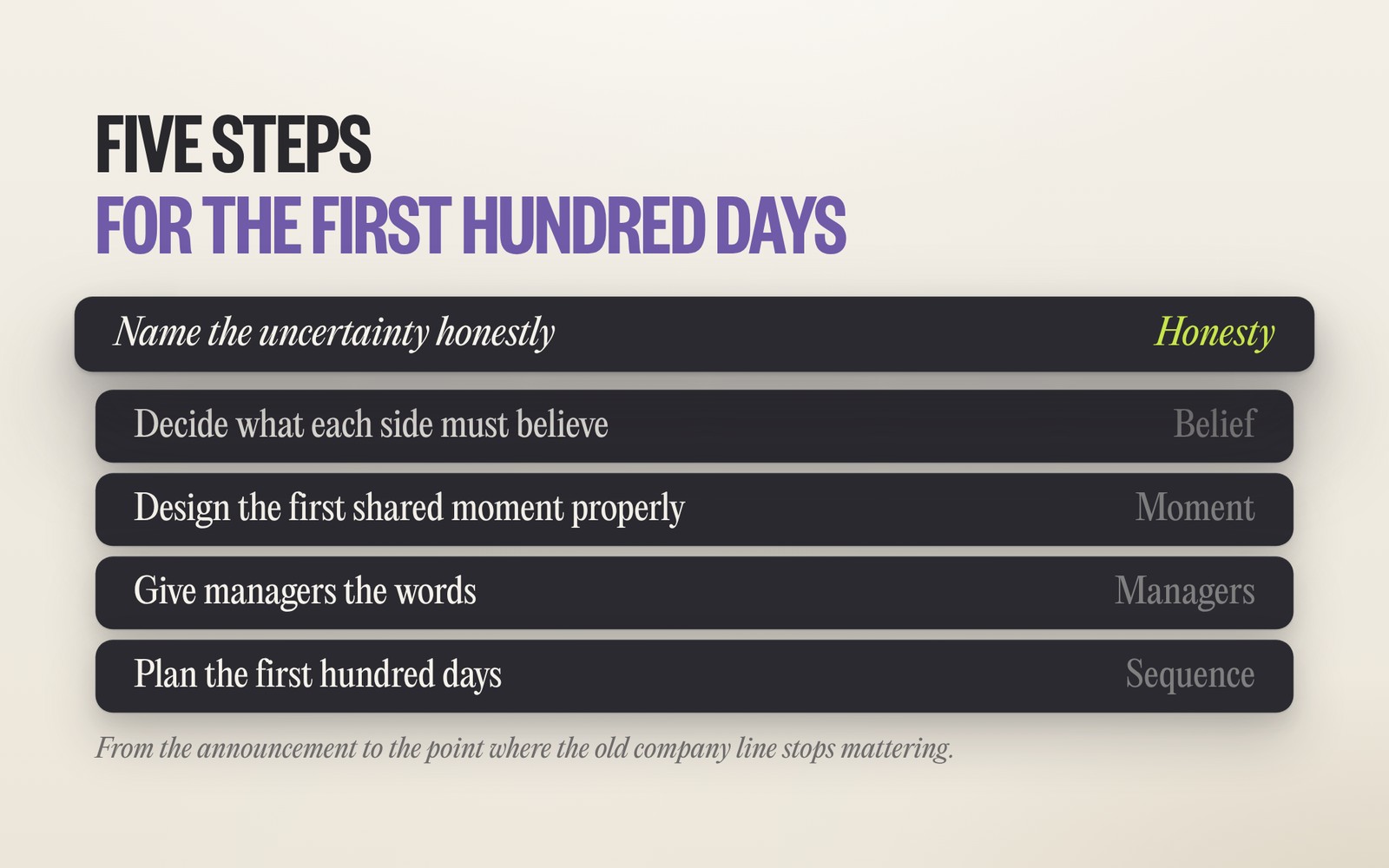
1. Name the uncertainty honestly
Say what people are already thinking. Yes, this is a big change. Yes, some things will be different. Yes, there are questions we can't answer yet, and here's when we will. Naming the uncertainty tends to calm people, because it shows leadership sees the same reality they do. Pretending everything is settled when it plainly isn't is the quickest way to lose a room.
2. Decide what each side must believe
Write one sentence for each workforce. By the end of the first hundred days, the acquired team should believe X, and the acquiring team should believe Y. If you can't write those sentences, you don't yet know what the integration is asking of people, and no event will fix that. Every later decision, from who speaks first to how the day ends, should come back to these two sentences.
3. Design the first shared moment properly
The first time both workforces are in one room is the most important moment of the integration, because it sets the tone for everything after it. Treat it as more than a briefing. People on both sides should leave having met each other, heard the hard questions asked and answered straight, and with a reason to work together.
4. Give managers the words
Internal communications research keeps finding that employees trust their direct manager more than any other source of information about the organisation. In a merger, managers are often as unsure as their teams, so they either go quiet or improvise. Give them the message, answers to the questions they'll be asked, and permission to say "I don't know yet" when it's true. A manager who can hold a steady conversation with their team does more for the integration than any single event.
5. Plan the first hundred days
One big event followed by silence can be worse than no event, because it confirms the suspicion that the effort was for show. Plan the moments after the first one: what gets repeated, what people see actually change, and when the next checkpoint is.
What this looked like for Perkbox and Vivup
When Perkbox and Vivup, two of the UK's best-known employee benefits businesses, merged, 450 people from both companies came together in person for the first time at the Atrium Hotel, Heathrow. The brief was to remove the "us and them" feeling, show everyone the direction of the combined business, and end the day as a celebration.
Three design decisions did most of the work.
The venue removed friction first. With people travelling from across the UK and abroad, we chose a venue that was easy for everyone to reach, so nobody started the day frustrated.
Meeting the other side became a game. Rather than forced introductions, people scanned codes on each other's lanyards to find out facts about colleagues and win points. Meeting someone from the other business became a reason to explore the room rather than a duty.
The hard questions had a place. A host ran the whole programme, including a Q&A with the CEO, so questions were asked in the room rather than whispered afterwards. A graduation ceremony recognised achievements from both legacy businesses, so neither side felt it was being written over.
The evening ran on from the day without a hard stop, and the room stayed one room into the night. The integration didn't end there. The new brand was launched to the business later, at a festival-format day for more than 300 people. A merger needs a sequence of moments like this, each with its own job. Read the full Perkbox and Vivup story.
The moments that carry a post-merger integration
A few moments do most of the work of post-merger integration for people. Naming them helps you design each one for its own job.
- The announcement. People decide in the first few minutes whether leadership is being straight with them. Honesty here buys patience later.
- The first company-wide event as one business. This is where belonging is won or lost. Mix the two sides on purpose rather than seating them across an aisle. Our all-hands meetings work is built for exactly this kind of moment.
- The checkpoints in the first hundred days. Team conversations, a town hall at the right moment, and visible decisions that prove the new direction is real. A lot of engagement is built between the big events.
- Leaders being seen. People want to see the people now deciding their future. Leaders who keep showing up and take the awkward questions hold a room that absent leaders lose.
Common mistakes that lose people
- Going quiet because things aren't final. The gap fills with rumour, and rumour is usually worse than the truth.
- Explaining the deal without addressing the fear. Running through the rationale and the org chart while ignoring the question everyone is holding: what does this mean for me?
- One big day, then nothing. People notice the silence that follows and read it as proof the day was for show.
- Treating a new logo as a merged culture. People experience culture in how decisions get made and whose way of working wins. A rebrand on its own changes neither.
- Forgetting the acquired side's sense of loss. Even a good deal is a loss for the side being bought. Saying so plainly earns more goodwill than pretending it's all upside.
How to tell if it's working
A satisfaction score taken on the day won't tell you much. The useful signals show up over weeks and months, so decide which ones you'll watch before the announcement.
- Regretted leavers. Are the people you most need still here at ninety days? Quiet early departures on the acquired side are the clearest warning sign.
- Whether people can explain the direction. A few weeks after the first event, can someone in either business tell you in a sentence why the deal happened and where it's going?
- Whether the two sides are mixing. Watch how teams form and whose names come up in the work. Integration is real when the old company line stops being the line people organise around.
When to bring in help
A lot of merger communication can and should stay in-house. Your people team knows the business, and the message belongs to leadership. Bring in a partner when the first shared moment carries real weight: two cultures that need to start working as one, a sceptical workforce, and a leadership team that needs to be present in the room rather than running it.
That's the work we do. We design and run M&A integration events and the change moments around them, often before the deal is public, so two workforces leave with a reason to work together.
Frequently asked questions
When should you tell employees about a merger?
As early as the deal allows, and straight away once it's public. People sense change before it's announced, and silence is read as bad news. You can't always say everything early, but you can say what you know, name what you don't, and commit to when you'll say more.
What should the first post-merger company event cover?
Less than most leaders expect, said more honestly. Why the deal happened, where the combined business is going, and what it means for the people in the room, including the parts that aren't settled. Leave real time for hard questions and answer them straight.
How do you bring two company cultures together?
Through how the integration is run. A new logo doesn't merge two cultures. How decisions get made, whose ways of working are respected, and whether the acquired side feels valued rather than erased all do. Acknowledge both cultures, decide what the combined business wants to keep, and let people see it.
How long does merger engagement take?
The first hundred days set the tone, but integration takes longer than that. Plan engagement as a sequence across the first year, with the first hundred days earning you the right to the rest.
If you're going through a merger or acquisition, tell us about the deal and the team: the rough timing, the combined headcount, and what the first shared moment has to achieve. We'll come back within one working day with how we'd approach it. Tell us about your merger.